CVPR 2026 runs dozens of workshops alongside the main conference, and picking the right one can matter more for getting your paper read than the venue itself. This list ranks the 15 workshops worth targeting by research fit, track record, and how well each pairs with a benchmark challenge.
- NTIRE ranks best overall among CVPR 2026 workshops on the strength of its long-running challenge tracks.
- Women in Computer Vision (WiCV) is the top pick for early-career researchers seeking visibility.
- VizWiz Grand Challenge Workshop wins for accessibility-focused vision research.
- CVPR 2026 workshop deadlines typically fall after the main conference decision date, giving rejected papers a second shot.
- Aiworkshoptracker.com tracks submission deadlines and extensions for CVPR 2026 workshops in one place.
Why this matters
CVPR's main track rejects far more papers than it accepts, and workshops are where most of that work finds a home in 2026. A paper aimed at the wrong workshop gets skimmed by reviewers who don't work in that niche, while the right one puts it in front of people already citing similar work. Workshop deadlines also move independently of the main CVPR 2026 deadline, so a paper rejected from the main track can often still make a workshop's later submission window. Submission windows, extensions, and accepted-paper lists for CVPR 2026 workshops are tracked on Aiworkshoptracker as they update.
Best overall: NTIRE (New Trends in Image Restoration and Enhancement). Best for early-career visibility: Women in Computer Vision (WiCV). Best for accessibility research: VizWiz Grand Challenge Workshop.
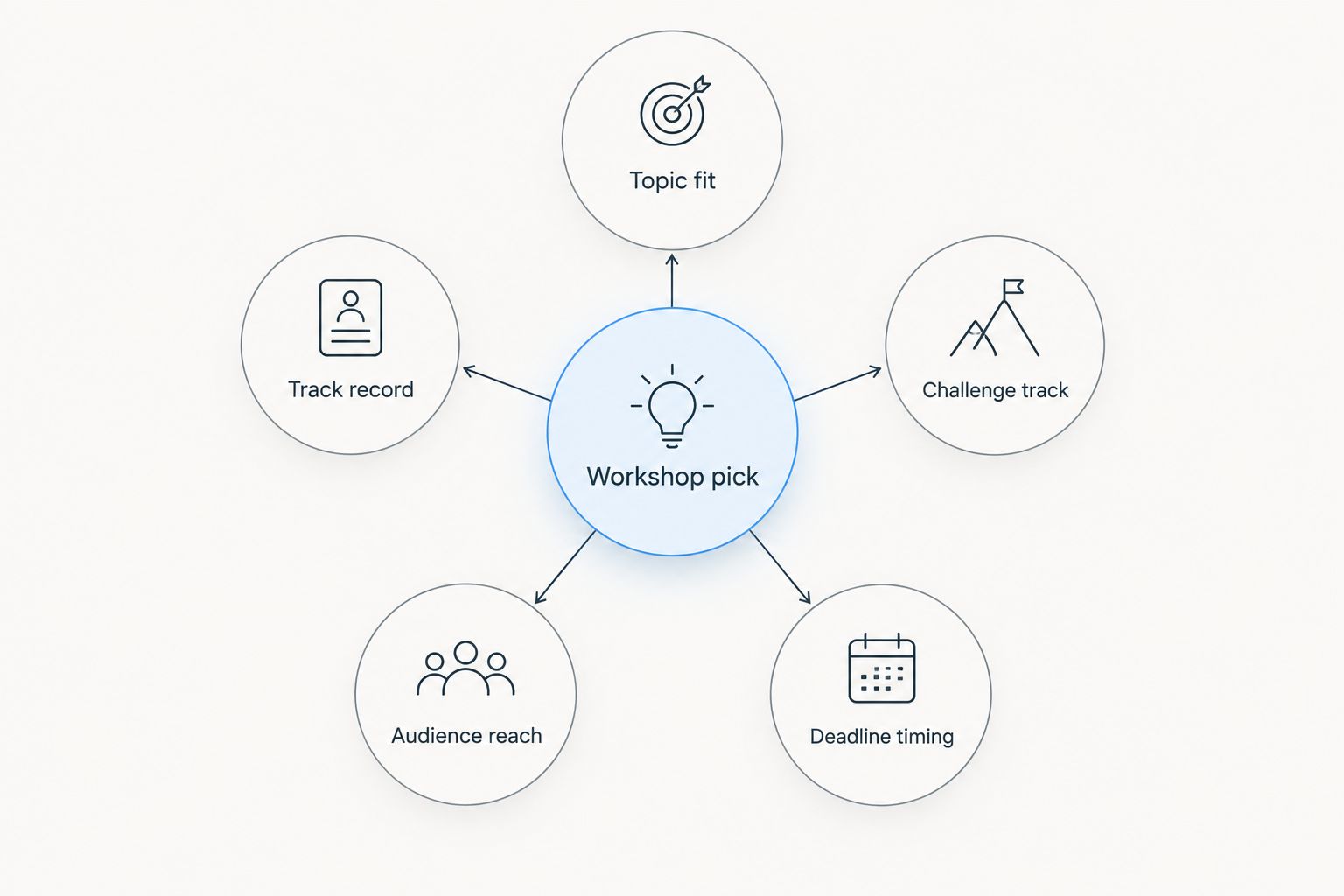
What makes a strong CVPR 2026 workshop pick
- Topic fit — the workshop's stated scope matches your paper's method, not just its application area
- Track record — the workshop has run at multiple prior CVPR editions rather than appearing once and vanishing
- Challenge pairing — workshops tied to a benchmark or challenge track pull larger, more engaged audiences
- Audience reach — the workshop serves a community you actually want citing your work
- Deadline timing — the submission window sits far enough after the main CVPR decision to absorb resubmissions
CVPR 2026 workshops at a glance
| Workshop | Best for | Focus area | Key limitation |
|---|---|---|---|
| NTIRE | Broadest overall fit | Image restoration and enhancement challenges | Highly competitive, industry-heavy field |
| WAD | Autonomous driving perception | Self-driving and traffic scene understanding | Narrow scope outside driving work |
| WiCV | Early-career visibility | Cross-topic vision research, mentorship | Not centered on one technical niche |
| VizWiz | Accessibility research | Vision for blind and low-vision users | Small, specialized reviewer pool |
| CLVision | Continual learning | Lifelong and incremental learning methods | Limited to continual-learning framing |
| FGVC | Fine-grained classification | Species, product, fine-grained categorization | Narrow use outside classification |
| LXAI | LatinX researcher visibility | Cross-topic vision, community building | Community-focused, not method-specific |
| AI City Challenge | Smart-city analytics | Traffic and multi-camera tracking | Tied closely to challenge datasets |
| ECV | Model efficiency | Compression, quantization, edge deployment | Less visibility than flagship workshops |
| L2ID | Low-data learning | Weak supervision, limited-label methods | Overlaps with broader few-shot venues |
| WMF | Media forensics | Deepfake and manipulation detection | Narrow, fast-moving subfield |
| Generative Models for CV | Generative and diffusion research | Image and video generation methods | Crowded pool given topic popularity |
| 3D Scene Understanding | 3D reconstruction research | Scene geometry, depth, reconstruction | Poor fit for 2D-only methods |
| Vision-and-Language | Multimodal research | Captioning, VQA, grounding | Broad scope can dilute reviewer expertise |
| Embodied AI | Robotics-adjacent vision | Navigation, manipulation, simulation | Requires embodied, not pure-perception, framing |
1. NTIRE — best for image restoration and enhancement research
NTIRE runs alongside CVPR as one of the longest-continuing workshop series, pairing a workshop track with multiple restoration and enhancement challenges. It draws large submission volumes from academic and industry teams working on super-resolution, denoising, and related tasks. Strengths: long track record, strong benchmark pairing. Watch-outs: competitive field, industry teams dominate leaderboards. Verdict: Submit.
2. Workshop on Autonomous Driving (WAD) — best for self-driving perception research
WAD focuses on perception, prediction, and planning problems specific to autonomous vehicles, usually paired with a driving-scene challenge. It suits papers grounded in real driving data rather than general scene understanding. Strengths: direct audience of driving-focused researchers. Watch-outs: narrow scope shuts out adjacent robotics work. Verdict: Submit.
3. Women in Computer Vision (WiCV) — best for early-career visibility
WiCV accepts papers across computer vision topics with a mission to raise visibility for women researchers, pairing presentations with mentorship sessions. It suits a paper that needs an audience more than a narrow technical crowd. Strengths: built-in mentorship and networking. Watch-outs: not centered on one method area. Verdict: Submit.
4. VizWiz Grand Challenge Workshop — best for accessibility-focused vision research
VizWiz centers on vision systems for blind and low-vision users, often paired with a dataset challenge drawn from real user-submitted images. It's a tight fit for accessibility work and a poor fit for anything else. Strengths: highly engaged, specialized community. Watch-outs: small reviewer pool limits submission volume. Verdict: Submit.
5. CLVision — best for continual learning research
CLVision runs a workshop and challenge track focused on lifelong and incremental learning, where models adapt to new data without forgetting prior tasks. Strengths: dedicated continual-learning benchmark. Watch-outs: framing must center on continual or incremental learning specifically. Verdict: Submit.
6. Fine-Grained Visual Categorization (FGVC) — best for fine-grained classification research
FGVC has run at CVPR for over a decade, covering species identification, product recognition, and other fine-grained categorization problems, often with paired datasets. Strengths: long-running, well-cited proceedings. Watch-outs: narrow applicability outside classification tasks. Verdict: Submit.
7. LatinX in AI (LXAI) Workshop — best for LatinX researcher visibility
LXAI accepts cross-topic vision research with a focus on building community and visibility for LatinX researchers in AI. Strengths: strong community and networking value. Watch-outs: not organized around a single technical theme. Verdict: Consider.
8. AI City Challenge Workshop — best for smart-city and traffic analytics research
The AI City Challenge pairs its workshop with multi-camera tracking and traffic analytics datasets, drawing teams working on smart-city and surveillance-adjacent vision problems. Strengths: strong challenge-driven engagement. Watch-outs: results tied closely to specific challenge datasets. Verdict: Submit.
9. Efficient Deep Learning for Computer Vision (ECV) — best for model efficiency research
ECV covers compression, quantization, and edge deployment of vision models, appealing to researchers optimizing for inference cost rather than raw accuracy. Strengths: growing relevance as deployment costs matter more. Watch-outs: less visibility than flagship workshops. Verdict: Consider.
10. Learning from Limited or Imperfect Data (L2ID) — best for low-data and weak-supervision research
L2ID focuses on methods that work under weak, noisy, or scarce labels, a growing area as labeled data collection gets more expensive. Strengths: focused scope, active reviewer community. Watch-outs: overlaps with broader few-shot and self-supervised venues. Verdict: Consider.
11. Workshop on Media Forensics (WMF) — best for deepfake detection research
WMF centers on detecting manipulated images and video, a subfield moving fast enough that workshop proceedings often beat journals to new benchmarks. Strengths: fast-moving, high-relevance topic. Watch-outs: narrow scope, small but sharp reviewer pool. Verdict: Submit.
12. Generative Models for Computer Vision Workshop — best for diffusion and generative research
This workshop covers image and video generation methods, from diffusion models to GAN-based approaches, and draws one of the largest submission pools at CVPR given how crowded generative research has gotten. Strengths: high visibility topic. Watch-outs: acceptance is competitive given submission volume. Verdict: Consider.
13. 3D Scene Understanding Workshop — best for 3D reconstruction research
This workshop covers scene geometry, depth estimation, and reconstruction methods, suiting papers that go beyond 2D image understanding. Strengths: dedicated 3D-focused reviewer pool. Watch-outs: poor fit for purely 2D methods. Verdict: Submit.
14. Vision-and-Language Workshop — best for multimodal research
This workshop covers captioning, visual question answering, and grounding tasks that combine vision and language models. Strengths: broad, active multimodal community. Watch-outs: broad scope can dilute reviewer expertise on narrow methods. Verdict: Submit.
15. Embodied AI Workshop — best for robotics-adjacent vision research
Embodied AI covers navigation, manipulation, and simulation tasks where vision models act in an environment rather than just classify it. Strengths: strong overlap with robotics venues like CoRL and IROS. Watch-outs: requires framing around embodied or interactive tasks, not pure perception. Verdict: Submit.
How we ranked these CVPR 2026 workshops
Track record, benchmark pairing, and audience fit drove this ranking, not raw popularity. A workshop with a huge submission pool but reviewers spread thin across unrelated topics ranks lower than a focused venue with dedicated reviewers who actually work in that subfield.
“The right CVPR 2026 workshop puts a paper in front of reviewers already citing similar work; the wrong one buries it.”
Which CVPR 2026 workshop should you submit to?
Default to NTIRE if your paper touches restoration, enhancement, or a related low-level vision problem — it has the longest track record and the largest built-in audience. Pick WiCV if visibility and mentorship matter as much as technical fit. For anything outside general vision, match the workshop to the subfield: WAD for driving, VizWiz for accessibility, WMF for forensics. When still unsure, submit to two workshops in different niches rather than betting everything on one CVPR 2026 deadline.
Track every CVPR 2026 deadline
Free tracker for workshop submission dates, extensions, and accepted papers.
FAQ
What is the best CVPR 2026 workshop to submit a paper to?
It depends on topic fit: NTIRE leads for restoration and enhancement work, WiCV for early-career visibility, and VizWiz for accessibility research. Match the workshop's stated scope to your paper's method before its application area.
How many workshops does CVPR run in 2026?
CVPR runs a large slate of workshops each year, covering topics from autonomous driving to generative vision. The exact count and final program are confirmed closer to the conference.
Are CVPR 2026 workshop deadlines different from the main conference deadline?
Yes, workshops set their own deadlines that typically fall after the main CVPR 2026 decision date. This gives papers rejected from the main track a realistic path to a workshop.
Is submitting to a CVPR 2026 workshop free?
Submitting a paper is generally free, but at least one author usually needs to register for the conference to present accepted work. Registration terms are set by CVPR closer to the event.
Can I submit a rejected CVPR main-track paper to a workshop?
Yes, this is common practice. Many workshops accept resubmissions of work reviewed elsewhere, provided the paper fits the workshop's stated scope.
Do CVPR 2026 workshops publish accepted papers?
Many do, through workshop proceedings or open preprint servers, but publication format varies by workshop. Check each workshop's page for its specific policy.
Which CVPR 2026 workshop is best for early-career researchers?
Women in Computer Vision (WiCV) and LatinX in AI (LXAI) both center visibility and mentorship over narrow technical fit, making them strong picks for researchers early in their careers.
How do I track CVPR 2026 workshop deadlines?
A community-maintained tracker lists submission deadlines, extensions, and accepted-paper lists across CVPR 2026 workshops so you don't have to check each workshop page individually.
One last thing
Workshop deadlines commonly land two to four weeks after the CVPR 2026 main-track decision date, which means a paper rejected from the main conference often still has a live shot at a workshop most people assume is already closed. Check each workshop's own page rather than assuming one fixed CVPR 2026 workshop deadline covers all of them — every workshop sets its own.