
ECCV 2026 runs on the same two-year cycle as every prior edition, and its workshop program opens, extends, and closes on a rolling schedule well before the main conference dates. This guide ranks the workshop types worth prioritizing for a submission and tells you exactly what to check before you commit a paper to one.
- Topic fit beats deadline speed when picking among ECCV 2026 workshops — an off-topic paper gets desk-rejected regardless of quality.
- Archival-track workshops carry more publication weight than non-archival poster or extended-abstract tracks.
- ECCV workshop deadlines get extended more often than main-track deadlines — verify the current date before you plan your writing schedule.
- aiworkshoptracker.com tracks open calls, extensions, and accepted-paper lists across ECCV, CVPR, NeurIPS, ICLR, and ICML editions.
- The workshop with the most runway left before its deadline is rarely the best topic match — check both before deciding.
Why this matters
ECCV workshops don't share one submission window. Each workshop organizer sets its own call for papers, its own deadline, and its own archival policy — and those details shift as often as they're announced. A workshop that looked open in January can close, extend, or quietly cancel by March.
That volatility is why picking "the best ECCV 2026 workshop" isn't a fixed list — it's a filtering exercise you run against live data. aiworkshoptracker.com keeps the current state of ECCV workshop calls, deadline extensions, and accepted-paper counts in one place so you're not cross-referencing a dozen workshop websites by hand.
What makes the best ECCV workshop for your paper
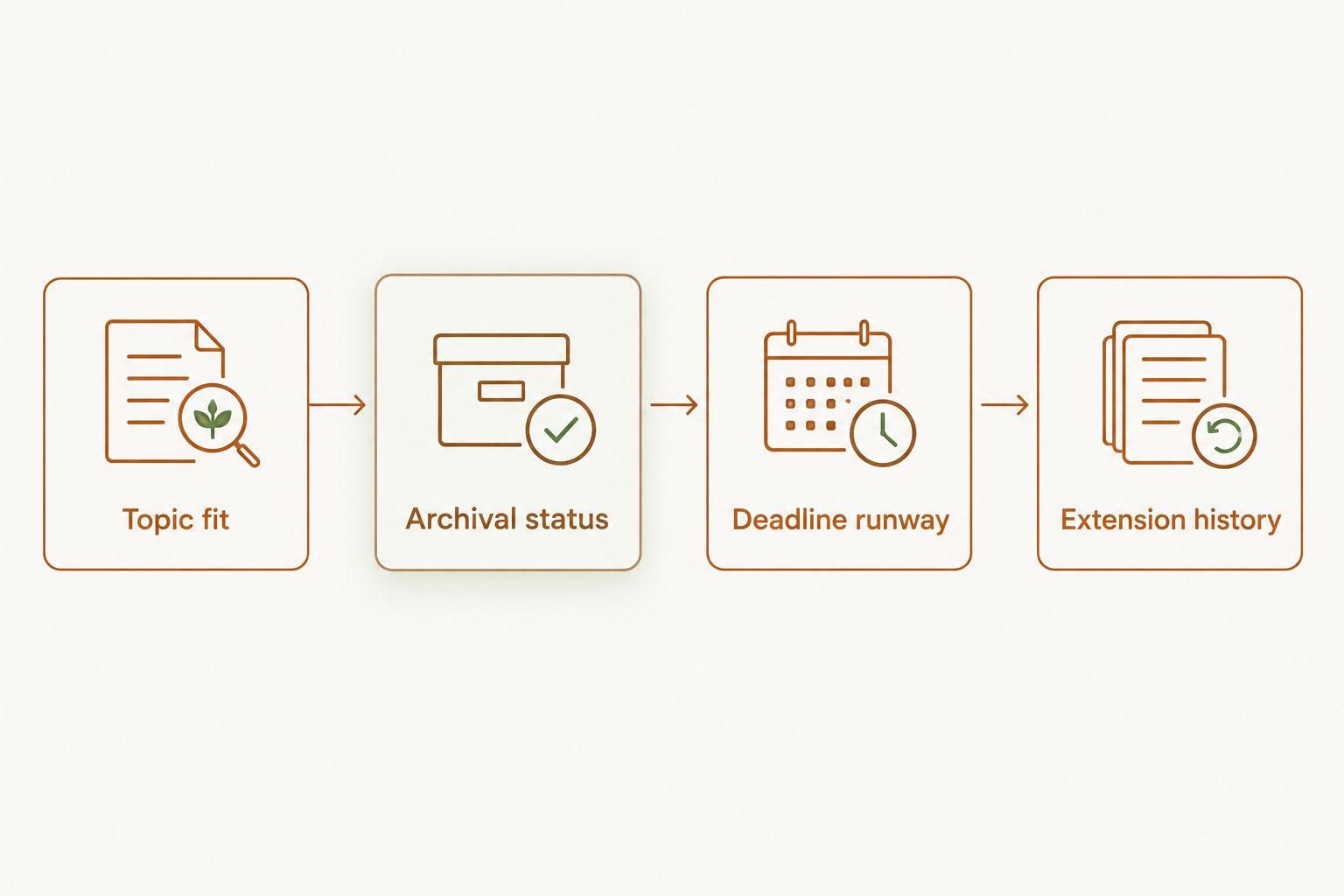
- Topic fit — the workshop's stated scope matches your paper's method, not just its keywords.
- Archival status — proceedings are indexed (counts as a citable publication) versus non-archival (extended abstract, no formal record).
- Deadline runway — enough days between now and the submission date to finish experiments and writing.
- Extension history — whether the workshop has already pushed its deadline once, which signals how firm the next date is.
- Camera-ready flexibility — whether accepted authors can add results after acceptance, useful if experiments are still running.
- Co-location logistics — whether the workshop runs alongside the main ECCV 2026 program or as a satellite event.
At a glance: how to weigh each criterion
| Criterion | What to check | Why it matters | Where to verify |
|---|---|---|---|
| Topic fit | Workshop's CFP scope vs. your paper's method | Reviewers score off-topic submissions lower no matter the quality | Workshop CFP page |
| Archival status | Indexed proceedings vs. extended abstract | Determines if the paper counts as a formal publication | Workshop CFP / tracker |
| Deadline runway | Days left before the submission deadline | Determines whether you can realistically finish the paper | aiworkshoptracker.com |
| Extension history | Has the deadline already moved once | Second extensions are common; first extensions are less predictable | Tracker deadline history |
| Camera-ready flexibility | Can accepted papers add results post-acceptance | Matters if your experiments are still running | Workshop CFP |
1. Topic-matched workshops: best for maximizing acceptance odds
A workshop built around your exact subfield — say, 3D reconstruction, diffusion models, or video understanding — reviews your paper against reviewers who work in that subfield daily. That's the single biggest lever on acceptance, bigger than polish or novelty framing.
Topic-matched workshops pros:
- Reviewers are subject-matter specialists, not generalists
- Feedback is more specific and usable for a future resubmission
- Networking at the session connects you with people already citing similar work
Topic-matched workshops cons:
- Narrow scope means fewer workshop options per ECCV 2026 cycle
- Popular subfields (vision-language, embodied AI) can be more competitive than niche ones
Best for: researchers whose paper has a clear, narrow methodological identity. Verdict: Submit first — check this before anything else on the list.
2. Archival-track workshops: best for publication-credit weight
Some ECCV workshops publish an indexed proceedings volume; others only post a webpage of accepted titles. The first counts on a CV and in citation counts. The second is a talk slot, not a publication.
Archival-track workshops pros:
- Citable, indexed record of the work
- Counts toward publication metrics for grants, job applications, and tenure files
- Signals a more established, longer-running workshop series
Archival-track workshops cons:
- Often stricter formatting and length requirements
- Review timelines can run longer than non-archival tracks
Best for: researchers who need the paper to count as a formal output. Verdict: Submit first when archival status is confirmed.
3. Non-archival / extended-abstract workshops: best for in-progress work
These tracks accept shorter submissions — often 2-4 pages — without a formal proceedings record. They exist to surface early results, position papers, and negative findings that wouldn't survive a full review cycle elsewhere.
Non-archival workshops pros:
- Lower bar for polish; ideas can be presented before every experiment is finished
- Faster turnaround from submission to decision
- Good venue for negative results that a journal or main track would reject
Non-archival workshops cons:
- Doesn't count as a formal publication on most CVs
- Lower visibility than an archival proceedings entry
Best for: work still mid-experiment, or papers testing a new idea before a full submission. Verdict: Use as a backup, not a primary target.
4. Recently-extended-deadline workshops: best for papers finished close to the wire
When a workshop pushes its deadline once, it usually means submission volume was lower than organizers expected — which can mean a lighter reviewer load and, sometimes, softer competition. It doesn't mean lower quality standards.
Extended-deadline workshops pros:
- More writing time without missing the ECCV 2026 window
- Often signals reduced submission volume relative to slots available
Extended-deadline workshops cons:
- A second extension is unpredictable — don't count on it happening twice
- Extended deadlines sometimes correlate with less-established workshop series
Best for: authors who need extra days but already have a topic-matched workshop identified. Verdict: Wait and confirm the new date on the tracker before committing.
5. Robotics-adjacent workshops: best for cross-disciplinary vision work
ECCV consistently hosts workshops at the boundary of vision and robotics — embodied AI, egocentric vision, and 3D perception for manipulation are recurring themes across recent editions. If your paper also fits a CoRL or ICRA submission, one of these workshops is often the vision-conference equivalent.
Robotics-adjacent workshops pros:
- Reaches a robotics-adjacent audience a pure vision workshop won't
- Useful staging ground before a full CoRL or ICRA submission
Robotics-adjacent workshops cons:
- Smaller, more specialized reviewer pool
- Fewer of these run in any single ECCV cycle compared to core vision topics
Best for: papers straddling computer vision and robotics perception. Verdict: Submit if your paper genuinely bridges both fields; skip if it's vision-only with a robotics label attached for reach.
How we ranked these
The order above follows the criteria listed earlier: topic fit first, archival status second, deadline flexibility third. A workshop that scores well on topic fit but publishes no proceedings still outranks one with a perfect deadline and a mismatched scope — the paper's long-term value depends more on fit and record than on timing.
Which ECCV 2026 workshop should you choose?
If you only check one thing before submitting, check topic fit against the workshop's current call for papers. The default recommendation for most researchers in 2026 is a topic-matched, archival-track workshop with at least two to three weeks of runway before its deadline — that combination maximizes both acceptance odds and the value of the resulting publication. Everything else on this list is a fallback for specific situations: unfinished experiments, robotics crossover work, or a deadline that's already tight.
Check open ECCV 2026 calls
See current deadlines, extensions, and accepted-paper counts live.
FAQ
What's the best ECCV 2026 workshop to submit a paper to?
There's no single best workshop for every paper — the best fit is the one whose call for papers matches your method and offers an archival proceedings track. Check the workshop's current status on aiworkshoptracker.com before deciding.
Is an ECCV workshop paper as valuable as a main-conference paper?
No — main-track ECCV papers carry more weight than workshop papers in almost every case. An archival workshop paper still counts as a citable publication, while a non-archival one typically does not.
Can I submit the same paper to multiple ECCV 2026 workshops?
Most workshops prohibit dual submission of the same paper within the same conference cycle. Check each workshop's CFP for its specific dual-submission policy before submitting to more than one.
What happens if an ECCV workshop deadline gets extended?
An extension pushes the submission window later without changing review standards. Extensions are common at the workshop level and get tracked as they're announced on aiworkshoptracker.com.
Are ECCV workshop papers indexed on Google Scholar?
Only archival workshop papers with an indexed proceedings volume typically show up in citation databases. Non-archival extended abstracts usually don't get indexed.
How do I find open ECCV 2026 workshop calls?
Check a live tracker rather than a single workshop's website, since calls open and close independently of the main conference. aiworkshoptracker.com aggregates open calls across ECCV workshop editions in one list.
Is submitting to an ECCV workshop harder than a CVPR or NeurIPS workshop?
Difficulty varies by workshop, not by conference — a competitive ECCV workshop can be harder to get into than an under-subscribed CVPR or NeurIPS one. Topic fit and submission volume matter more than which conference hosts it.
One last thing
ECCV alternates with ICCV on a two-year cycle, and most of its workshops run as single-day sessions colocated with the main program — ECCV 2024 was held in Milan, Italy, as a point of reference for how the event is structured. That single-day format means workshop review cycles are compressed relative to the main track, which is exactly why deadline runway matters as much as topic fit when you're picking one for 2026.