
IROS 2026 workshops don't reduce to one clear winner — the program splits into recurring theme clusters, and the right cluster for your paper depends on scope fit, not on which workshop name sounds biggest. This guide ranks those clusters by fit, using how IROS workshops have actually run in past editions rather than guessing at a single 2026 favorite before calls for papers are even confirmed.
- IROS 2026 workshops cluster into recurring themes; manipulation and grasping workshops have the deepest reviewer pool edition after edition.
- Robot-learning and sim-to-real workshops are the best fit for deep learning-heavy papers that don't belong in the IROS main track.
- No single IROS 2026 workshop call for papers is confirmed as open in this guide — verify every deadline on AI Workshop Tracker before committing a paper.
- Field, agricultural, and underwater robotics workshops draw smaller submission pools than manipulation or HRI tracks, which can mean faster, less competitive review.
Why this matters
Most researchers pick a workshop the same way they pick a restaurant on a road trip: whatever's closest to the deadline. That works until the paper gets rejected for scope mismatch, or the workshop's call for papers closes two weeks before anyone on your team noticed it opened.
AI Workshop Tracker's open-calls list exists because IROS, ICRA, CVPR, and NeurIPS workshops don't share one deadline calendar — each organizer sets its own call for papers, extension, and acceptance timeline, and IROS 2026 is no different. Treating workshop selection as a fit problem, not a timing accident, is the difference between a paper that lands and one that gets desk-rejected for being off-topic.
That's the frame for this ranking: which IROS workshop theme fits which paper type, so you know where to look before a specific 2026 call for papers even goes live.
What makes the best IROS 2026 workshop to submit to
- Recurrence — has the theme run at IROS across multiple past editions, or is it a one-off
- Scope fit — does the call for papers language match your core contribution, not just your robot platform
- Deadline spacing — does the workshop deadline land late enough to catch reworked IROS main-track rejects
- Publication outlet — does the workshop post accepted papers publicly, or just accept a talk slot with no record
- Reviewer pool size — a rough read on competitiveness based on how many editions and past accepted papers the theme has run
Best overall for IROS 2026: manipulation and grasping workshops — the most consistent theme cluster across IROS editions, with the deepest reviewer pool. Best for deep learning and foundation-model papers: robot-learning and sim-to-real workshops. Best for a smaller, faster-turnaround pool: field, agricultural, and underwater robotics workshops.
At a glance
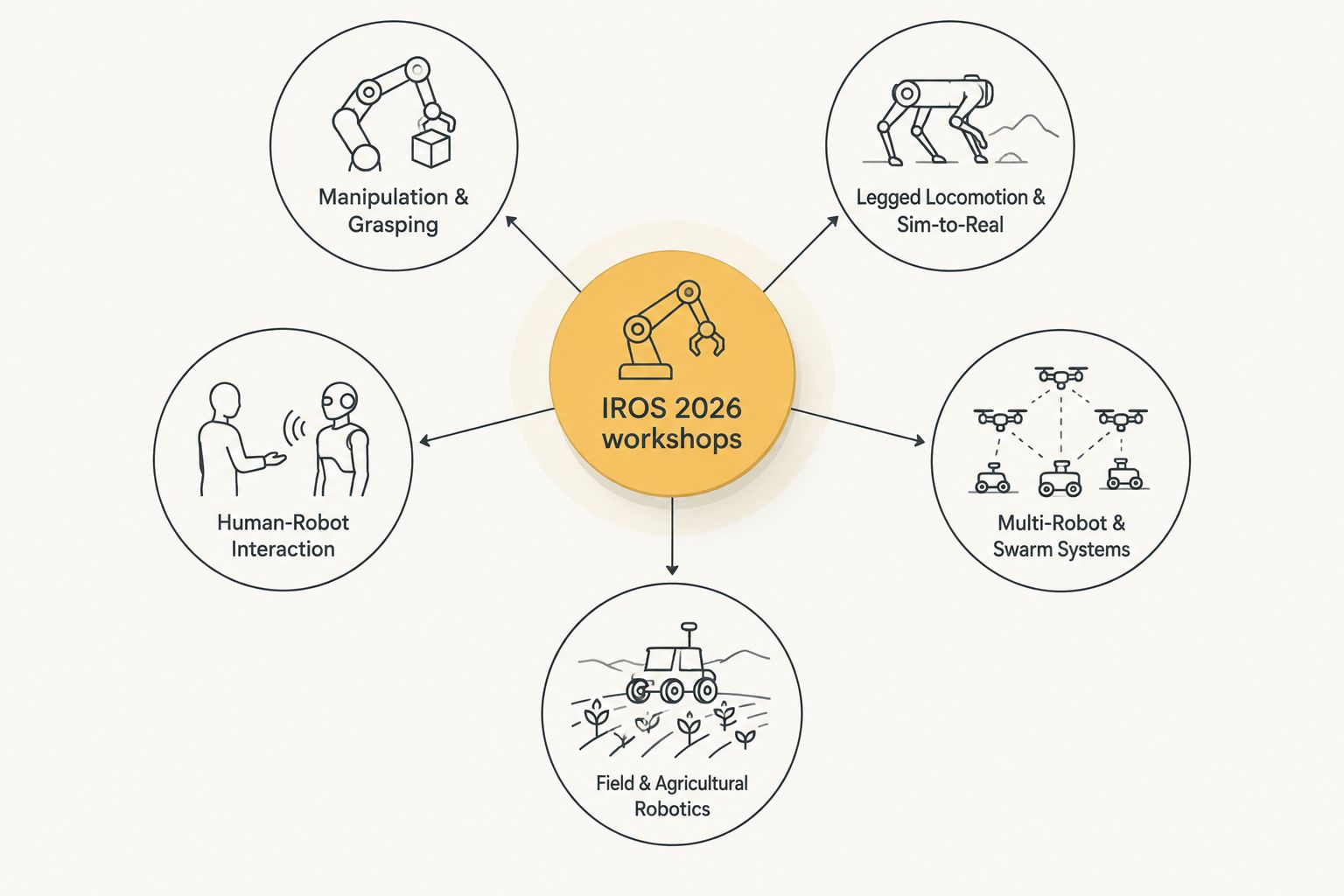
| Theme cluster | Best for | Standout characteristic | Key limitation |
|---|---|---|---|
| Manipulation & Grasping | Dexterity, grasping, tactile sensing papers | Runs in nearly every IROS edition | Largest submission volume, most competitive |
| Legged Locomotion & Sim-to-Real | Legged control, RL, transfer-learning papers | Direct pipeline from top robot-learning labs | Requires hardware validation for full papers |
| Human-Robot Interaction | HRI, social robotics, teleoperation papers | Cross-disciplinary reviewer pool | Narrower fit for pure hardware/perception papers |
| Multi-Robot & Swarm Systems | Coordination, distributed control papers | Specialist, smaller reviewer pool | Fewer editions in some years — check the tracker for gaps |
| Field, Agricultural & Underwater Robotics | Domain-specific deployment papers | Lower submission competition | Narrower audience, lower cross-citation reach |
1. Manipulation & Grasping: best IROS workshop for dexterity and tactile-sensing papers
Manipulation and grasping is the most stable theme in the IROS workshop program — it's shown up in some form at nearly every recent edition, which means organizers, reviewer pools, and community expectations are mature. If your paper covers dexterous manipulation, tactile sensing, or grasp planning, this is the default cluster to check first on AI Workshop Tracker's IROS 2026 list.
Manipulation & Grasping pros:
- Largest, most established reviewer community among IROS workshop themes
- Scope language tends to be broad enough to fit adjacent subtopics (force control, in-hand manipulation, soft grippers)
- High visibility — attendees at these workshops skew toward manipulation-focused labs, which matters for networking a niche result
Manipulation & Grasping cons:
- Highest submission volume also means the toughest relative acceptance bar
- Broad scope can mean less specialized feedback if your contribution is very narrow
Best for: dexterity, grasping, and tactile-sensing papers. Verdict: Submit — check the tracker for the live 2026 call before assuming last year's deadline pattern repeats.
2. Legged Locomotion & Sim-to-Real: best IROS workshop for RL and transfer-learning papers
This cluster sits at the intersection of control theory and robot learning — quadruped and bipedal locomotion papers, sim-to-real transfer methods, and reinforcement learning applied to embodied agents. It's also where main-track IROS rejects with a strong RL component often land after reworking.
Legged Locomotion & Sim-to-Real pros:
- Strong fit for papers that overlap robot learning and control
- Reviewer pool skews toward labs actively publishing at NeurIPS and ICML robotics workshops too, so feedback tends to be current
- Good venue for early results that need hardware validation before a full conference submission
Legged Locomotion & Sim-to-Real cons:
- Sim-only papers without any hardware or transfer discussion can read as thin here
- Overlaps heavily with robot-learning workshops at NeurIPS and ICML, so competition isn't limited to IROS attendees
Best for: RL-heavy and sim-to-real transfer papers. Verdict: Submit if you have transfer or hardware results; Wait if the paper is purely simulation with no real-robot component.
3. Human-Robot Interaction: best IROS workshop for HRI and teleoperation papers
HRI workshops at IROS draw a cross-disciplinary crowd — roboticists, HCI researchers, and cognitive science labs. If your paper touches social robotics, teleoperation interfaces, or human-in-the-loop control, this cluster's scope language is usually written broadly enough to include work that wouldn't fit a pure controls or perception track.
Human-Robot Interaction pros:
- Reviewer pool includes non-roboticists, which helps papers with a strong user-study or interaction-design component
- Scope tends to welcome mixed-methods papers (quantitative + qualitative)
- Good fit for early-stage interaction concepts that aren't ready for a full HRI conference submission
Human-Robot Interaction cons:
- Pure hardware or perception papers with no human-in-the-loop element are a weak fit
- Smaller overlap with core manipulation/locomotion audiences at the conference
Best for: HRI, social robotics, and teleoperation papers. Verdict: Submit if there's a human-interaction component; Skip if the paper is purely autonomous-system focused.
4. Multi-Robot & Swarm Systems: best IROS workshop for coordination and distributed control papers
This is the specialist end of the IROS workshop program — coordination algorithms, distributed control, swarm behavior, and multi-agent planning. The reviewer pool is smaller than manipulation or HRI, which can mean a faster, less crowded review process, but it also means fewer editions run in some years.
Multi-Robot & Swarm Systems pros:
- Smaller, specialist reviewer pool often means clearer, more technical feedback
- Less submission volume than manipulation or HRI clusters
- Strong fit for theoretical coordination and control-heavy papers
Multi-Robot & Swarm Systems cons:
- Not every IROS edition runs a dedicated multi-robot workshop — confirm the 2026 call exists before planning around it
- Narrower audience limits post-workshop networking reach compared to bigger clusters
Best for: coordination and distributed control papers. Verdict: Track — watch AI Workshop Tracker for the 2026 call for papers specifically, since this cluster doesn't run every year.
5. Field, Agricultural & Underwater Robotics: best IROS workshop for domain-deployment papers
This cluster covers robotics deployed outside the lab — field robotics, agricultural automation, underwater and marine systems. Submission volume here tends to run lower than the core manipulation and HRI clusters, which can make it a faster path to a workshop acceptance for a domain-specific result that wouldn't stand out in a bigger pool.
Field, Agricultural & Underwater Robotics pros:
- Lower competition relative to manipulation, locomotion, and HRI clusters
- Reviewer pool is domain-expert, which helps deployment-focused papers get relevant feedback
- Good fit for applied results that don't fit a general-purpose robotics narrative
Field, Agricultural & Underwater Robotics cons:
- Narrower audience means lower cross-citation reach outside the specific domain
- Fewer adjacent workshops at other conferences to cross-post similar work
Best for: domain-specific deployment papers. Verdict: Submit if your result is deployment-focused; Skip if the contribution is a general-purpose algorithm better suited to a broader cluster.
How this ranking works
The order above follows the criteria set earlier: recurrence across editions, scope fit, deadline spacing relative to the IROS main track, whether accepted papers get a public record, and rough reviewer-pool size based on past activity. Manipulation and grasping ranks first because it satisfies all five most consistently; multi-robot and field robotics rank lower only because they run less predictably year to year, not because the work matters less.
None of this substitutes for checking the actual 2026 call for papers. Scope language, deadlines, and even whether a given workshop runs at all can shift between editions — that's exactly what AI Workshop Tracker's open-calls list is built to catch.
Which IROS 2026 workshop theme should you choose?
If you're undecided, default to manipulation and grasping if your paper touches dexterity, tactile sensing, or grasp planning — it's the most stable, highest-volume cluster and the safest first check. If your work leans on reinforcement learning or sim-to-real transfer, go straight to legged locomotion and sim-to-real workshops instead. Everything else on this list is a better fit only if your paper's core contribution doesn't match either of those two.
Check the live IROS 2026 workshop calls
See which IROS-adjacent calls for papers are open before you pick a theme.
FAQ
What is IROS 2026?
IROS is the IEEE/RSJ International Conference on Intelligent Robots and Systems, one of the two largest annual robotics research conferences alongside ICRA. The 2026 edition runs an affiliated workshop program with calls for papers set independently by each workshop, not on one conference-wide schedule.
How many IROS 2026 workshops are there?
IROS typically runs several dozen affiliated workshops each edition, spanning manipulation, locomotion, HRI, multi-robot systems, and field robotics. Exact 2026 counts and open calls update live on AI Workshop Tracker as organizers post them.
Which IROS workshop theme gets the most submissions?
Manipulation and grasping workshops historically draw the largest submission pools among IROS theme clusters, edition after edition. That also makes them the most competitive relative to smaller clusters like multi-robot systems or field robotics.
Is an IROS workshop paper less valuable than a main-track paper?
Workshop papers generally carry less weight than main-track publications in most robotics hiring and tenure evaluations, but they're a faster, lower-stakes way to get early results reviewed and presented. Whether that trade-off matters depends on your career stage and the paper's maturity.
When do IROS 2026 workshop deadlines open?
Workshop deadlines run independently of the IROS main-track deadline and typically post after main-track decisions go out. There's no single date that applies across every workshop, so check AI Workshop Tracker's current 2026 call-for-papers list rather than assuming one deadline covers the whole program.
Can I submit a rejected IROS main-track paper to an IROS workshop?
Yes, in most cases. Many robotics conference workshops explicitly welcome reworked main-track rejects, and workshop scope language is often written to accommodate that. Confirm the specific workshop's call for papers allows it before resubmitting.
Do IROS workshops publish proceedings?
It varies by workshop. Some post accepted papers publicly on the workshop's own site, others only offer a presentation slot with no formal record. Check the specific workshop's call for papers or past editions for its publication practice.
How do I find open IROS 2026 workshop calls for papers?
AI Workshop Tracker maintains a running list of open calls for papers across IROS, ICRA, CVPR, NeurIPS, ICML, ICLR, and other AI/ML/robotics conferences. Checking that list directly is faster than searching individual workshop websites one at a time.
One last thing
The fastest way to find a workshop with room for your paper isn't scanning call-for-papers pages one at a time — it's cross-referencing which theme clusters have run every IROS edition against which ones skipped a year. A cluster that's missing from the current 2026 list but ran in prior editions is worth watching for a late call, not writing off entirely.