
ICRA 2026 doesn't publish one master workshop list. Organizers run dozens of independent satellite workshops, each with its own call for papers, its own deadline, and its own reviewing process. This guide ranks the workshop categories researchers submit to most often at ICRA, tells you what to check before you pick one, and points you to where the current 2026 calls actually live.
- ICRA 2026 workshops run on independent deadlines set by individual organizers, not one master submission date.
- Manipulation and grasping workshops draw the largest ICRA audience; sim-to-real and HRI workshops fill narrower gaps.
- Check proceedings archiving before submitting: not every ICRA 2026 workshop indexes accepted papers.
- A live tracker of ICRA 2026 workshop calls, deadlines, and extensions updates as organizers publish them.
Why this matters
A workshop paper gets you a focused audience, a faster review cycle, and often a second shot at feedback before a main-track or journal resubmission. But "ICRA 2026 workshops" isn't one call for papers. It's a loose collection of independently organized one- and two-day events, each set by its own organizing committee.
The live ICRA workshop tracker is the most reliable way to see which 2026 calls are open right now, because deadlines get set, moved, and extended on the organizers' own schedule, not IEEE's.
If you're deciding where to submit right now: manipulation and grasping workshops accept the widest range of ICRA-adjacent topics, sim-to-real and embodied-AI workshops fit best if your contribution leans reinforcement learning or transfer, and HRI workshops are the strongest option if your paper includes a human user study.
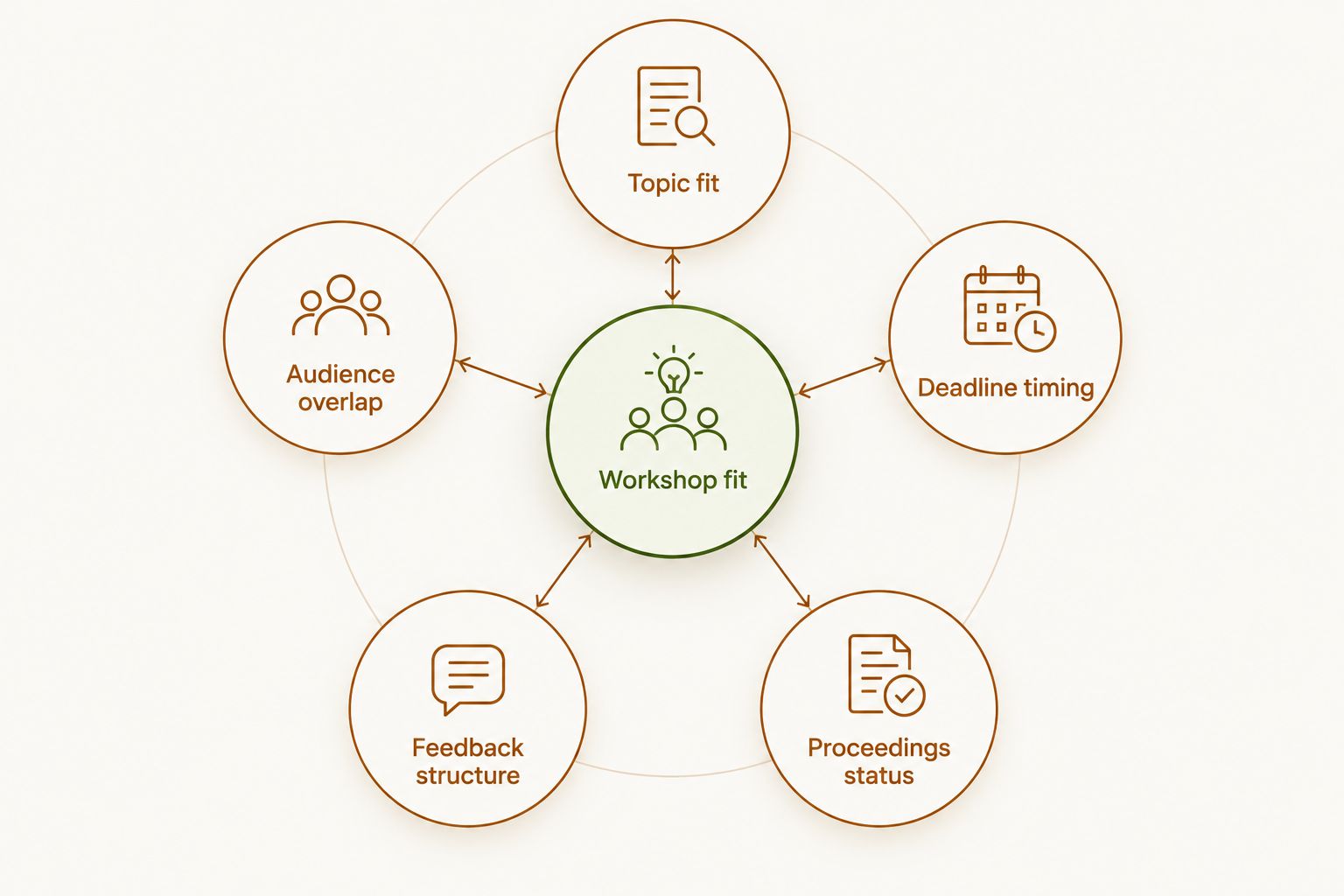
What makes the best ICRA 2026 workshop to submit to
- Topic fit — your contribution matches the workshop's stated scope, not just "robotics" broadly
- Deadline timing — enough runway after a main-track rejection, or before the workshop's own late deadline
- Proceedings status — whether accepted papers get archived, which affects citability later
- Feedback structure — some workshops give formal reviewer feedback or a rebuttal window, others don't
- Extension history — workshops that have extended before tend to extend again
- Audience overlap — organizers and invited speakers who actually work in your subfield
ICRA 2026 workshop categories at a glance
| Category | Best for | Standout trait | Key limitation |
|---|---|---|---|
| Manipulation & Grasping | Manipulation/grasping researchers | Largest ICRA-adjacent submission pool | Highest competition of the six categories |
| Legged Locomotion & Legged Robots | Locomotion and control researchers | Tight fit for hardware-validated control work | Narrow scope excludes non-locomotion papers |
| HRI & Social Robotics | Authors with a human-in-the-loop study | Dedicated non-core ICRA audience | Small pool if there's no user study |
| Sim-to-Real & Embodied AI | RL and transfer-learning authors | Bridges ICRA and ML-conference audiences | Overlaps with workshops at other venues |
| SLAM, Perception & Mapping | Perception and mapping researchers | Long-running ICRA workshop tradition | Established scope means stricter fit |
| Multi-Robot Systems & Field Robotics | Swarm and multi-agent researchers | Least crowded of the six categories | Smallest audience of the six |
Check open ICRA 2026 calls
See current workshop deadlines and extensions as organizers publish them.
1. Manipulation & Grasping Workshops: best for hands-on manipulation research
Manipulation and grasping is the most heavily represented topic at ICRA every year, and its workshops reflect that. Expect the largest applicant pool of any ICRA 2026 workshop category, along with invited talks pulled directly from industry robotic-arm and dexterous-hand programs.
Manipulation & Grasping pros:
- Widest scope for tangential contributions: grasp planning, tactile sensing, dexterous control
- Largest audience of any ICRA workshop category
- Frequently pairs with hardware demo sessions
Manipulation & Grasping cons:
- Highest submission volume means the toughest relative competition
- Broad scope can dilute feedback quality for niche subtopics
Verdict: Submit here if your paper is squarely about manipulation or grasping.
2. Legged Locomotion & Legged Robots Workshops: best for locomotion control research
These workshops sit close to hardware. Papers on gait control, balance, and legged platform design fit here more precisely than in a general robotics track.
Legged Locomotion pros:
- Tight topic match for gait control, balance, and legged hardware work
- Reviewers are typically hands-on hardware researchers
- Good fit for sim-to-real transfer work specific to legged platforms
Legged Locomotion cons:
- Scope is narrow: a manipulation or perception paper won't fit
- Smaller audience than manipulation workshops
Verdict: Submit here only if legged locomotion is the paper's core contribution; skip otherwise.
3. Human-Robot Interaction & Social Robotics Workshops: best for HRI research
HRI workshops give user-study and social-robotics papers an audience that the ICRA main track doesn't reliably provide.
HRI & Social Robotics pros:
- Dedicated audience for user studies, rare at the ICRA main track
- Feedback tends to focus on study design, not just technical novelty
- Good venue for early-stage or pilot-study results
HRI & Social Robotics cons:
- No fit for papers without a human-in-the-loop component
- Smaller submission pool than manipulation workshops
Verdict: Submit here if your paper includes a user study; skip if it doesn't.
4. Sim-to-Real & Embodied AI Workshops: best for sim-to-real research
This category sits between ICRA and the ML-conference world. Organizers and attendees often run or attend related workshops at NeurIPS and ICML, which means your competition isn't limited to ICRA submitters alone.
Sim-to-Real & Embodied AI pros:
- Strong overlap audience with reinforcement-learning and transfer-learning researchers
- Good bridge venue between ICRA and ML-conference audiences
- Attracts organizers who also run related workshops elsewhere
Sim-to-Real & Embodied AI cons:
- Topic overlap with other conferences' workshops means wider competition
- Scope can skew toward simulation benchmarks over hardware validation
Verdict: Submit here if your contribution is RL or transfer-learning heavy; hold if it's hardware-only.
5. SLAM, Perception & Mapping Workshops: best for perception and mapping research
SLAM and perception workshops are among the longest-running categories at ICRA, with established organizer bases that keep scope consistent year over year.
SLAM, Perception & Mapping pros:
- One of the longest-running workshop categories at ICRA
- Consistent year-over-year scope
- Frequently includes benchmark or challenge components
SLAM, Perception & Mapping cons:
- Established scope can mean stricter fit requirements
- Less room for cross-topic papers than newer categories
Verdict: Submit here if your paper is a clear SLAM, mapping, or perception contribution.
6. Multi-Robot Systems & Field Robotics Workshops: best for swarm and multi-agent research
The smallest category of the six by submission volume, and the most direct fit for field deployment and multi-agent coordination work.
Multi-Robot Systems pros:
- Least crowded of the six categories by submission volume
- Direct fit for field deployment and multi-agent coordination work
- Organizers often invite field-tested case studies
Multi-Robot Systems cons:
- Smallest audience of the six categories
- Fewer workshops exist in this category in a given year
Verdict: Submit here if multi-robot or field deployment is the paper's central contribution; skip if it's a side result.
“The right ICRA workshop for a manipulation paper is rarely the right one for a SLAM paper.”
How this ranking works
Categories above are ordered by submission-pool size and topic breadth, not by prestige. Topic fit, deadline timing, proceedings status, extension history, and audience overlap decided the order and the pros/cons in each section. A smaller category matched to your paper beats a bigger one that isn't.
Which ICRA 2026 workshop should you submit to?
If you're still undecided, start with the category whose scope names your paper's core contribution, not the one with the biggest audience. Manipulation & grasping wins on reach; HRI wins on fit for user studies; sim-to-real wins for RL-heavy work. Check the specific workshop's call for papers on the live tracker before you submit, since organizer-run deadlines shift more often than the main ICRA 2026 deadline does.
FAQ
What's the best ICRA 2026 workshop to submit a paper to?
It depends on your paper's topic. Manipulation and grasping workshops draw the largest ICRA audience, HRI workshops fit best for user-study papers, and sim-to-real workshops fit RL-heavy contributions.
When is the ICRA 2026 workshop submission deadline?
Each ICRA 2026 workshop sets its own deadline, independent of the main conference. Check that specific workshop's call for papers, or a live tracker, for the current date.
Are ICRA workshop papers archived or indexed?
Not universally. Some ICRA workshops archive accepted papers and others don't, so check the archiving policy in the call for papers before submitting if citation count matters to you.
Is submitting to an ICRA workshop harder than the main track?
Workshop review is typically lighter-weight than main-track review, but competitiveness varies by category. Manipulation and grasping workshops draw the largest applicant pool of the six.
Can I submit the same paper to multiple ICRA 2026 workshops?
Dual-submission policy varies by organizer. Check each workshop's call for papers for its rules before submitting the same paper to more than one.
Do ICRA workshops extend their deadlines?
Yes. Workshop deadlines are set by individual organizers and get extended more often than the main ICRA deadline, so check for updates close to the original date.
How is an ICRA workshop deadline different from the ICRA main-track deadline?
The ICRA main track has one submission deadline set centrally. ICRA workshops are independently organized satellite events, each with its own separate call and deadline.
Where can I find the current list of open ICRA 2026 workshop calls?
A live tracker of ICRA 2026 workshop calls, deadlines, and extensions covers open calls as organizers publish them, since no single official master list exists.
One last thing
Workshop deadlines are organizer-controlled, which means extensions happen more often than main-track deadline changes. Don't cross a workshop off your list just because its posted 2026 deadline has passed; check back close to that date before assuming the call is closed.