Choosing where to submit a workshop paper for ICLR 2026 comes down to fit, not prestige — a paper on LLM evaluation gets buried at a robotics workshop and vice versa. This guide ranks the workshop categories that recur at ICLR year over year and tells you which one fits which kind of paper.
- ICLR 2026 workshops split into recurring categories: foundation models/LLMs, embodied AI, safety/interpretability, efficient ML, applied science, and tiny-paper tracks.
- Foundation model and LLM evaluation workshops fit language-model papers best; embodied-AI tracks fit robot-learning papers.
- Tiny-paper and short-paper tracks are the lowest-friction entry point for preliminary or early-stage results.
- The confirmed 2026 roster, deadlines and extensions post gradually through the fall — check the live tracker before locking in a target.
Why this matters
The confirmed list of ICLR 2026 workshops isn't finalized this early in the cycle — calls for papers, deadlines and extensions post on a rolling basis as organizers lock in venues. What's stable, and useful for planning now, is the set of categories ICLR workshops have fallen into across recent editions. Ranking by category instead of by name lets you pick a target before a single 2026 call has even gone live, then swap in the exact workshop once it's posted.
Aiworkshoptracker tracks open calls, deadlines and extensions as they're announced, so the specific ICLR 2026 workshop names and dates belong there, not frozen into a static ranking that goes stale by October.
Best overall starting point: check the live ICLR 2026 workshop list before committing, since the roster fills in through the fall. Best for LLM and foundation-model researchers: the recurring foundation-model and evaluation workshop category. Best for robot-learning researchers: the embodied-AI and robotics workshop category. Best for preliminary or early-stage results: a tiny-paper or short-paper track.
What makes the best ICLR 2026 workshop for your paper
- Topic fit — the workshop's stated scope matches your paper's contribution, not just its keywords.
- Deadline position relative to camera-ready — a workshop deadline that lands well before ICLR's main camera-ready crunch gives you room to revise.
- Archival status — non-archival workshops let you resubmit the work elsewhere later; archival proceedings usually don't.
- Format — poster-only, oral-eligible, and extended-abstract formats suit different stages of a project differently.
- Review turnaround — workshops with fast, single-round review suit late-breaking results better than multi-round formats.
- Track continuity — a category that has run in some form across multiple ICLR editions is lower-risk than a brand-new one-off.
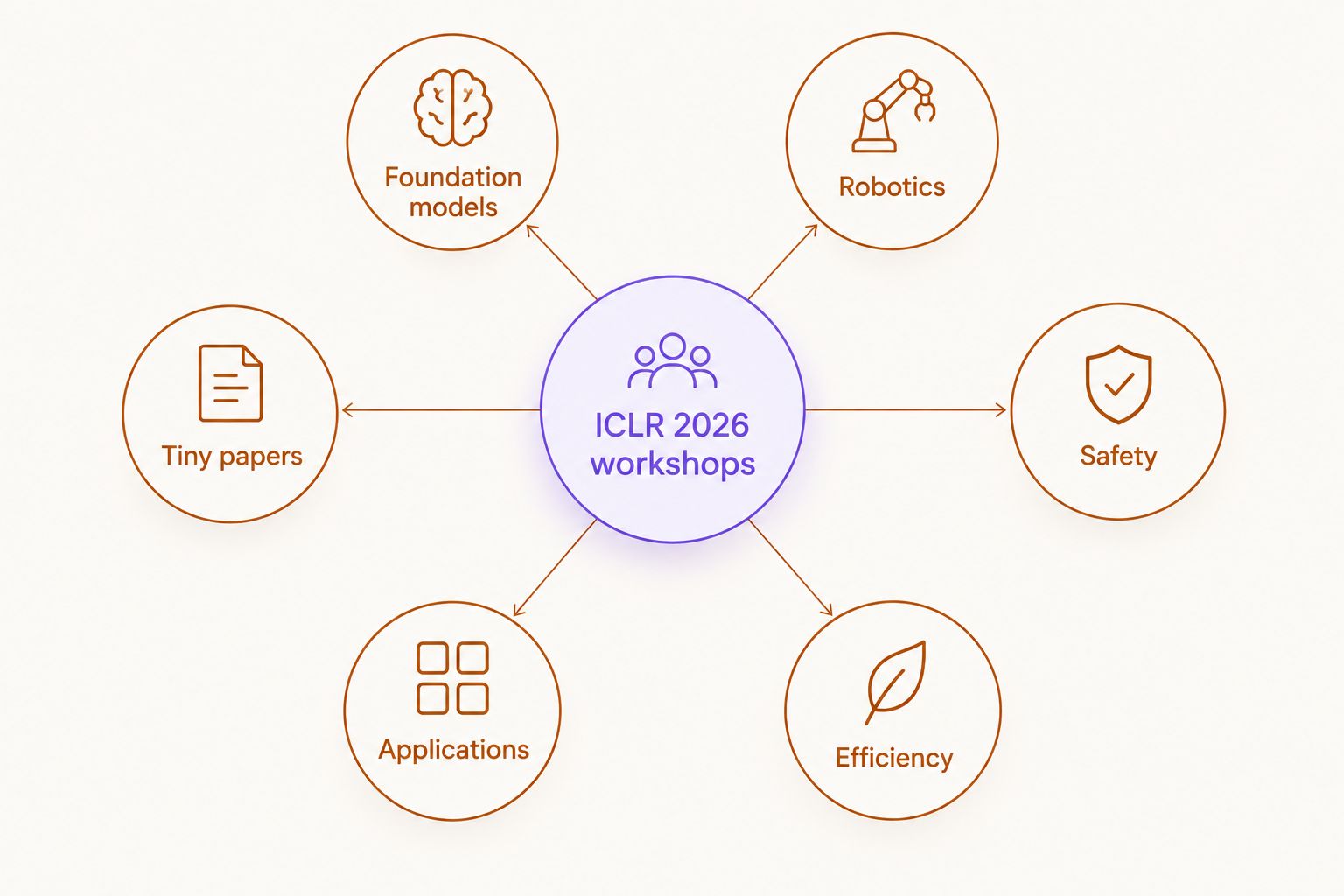
ICLR 2026 workshop categories at a glance
| Category | Best for | Standout feature | Key limitation |
|---|---|---|---|
| Foundation models & LLM evaluation | LLM and foundation-model researchers | Draws the largest, most active reviewer pool at ICLR | High submission volume means more competition |
| Embodied AI & robot learning | Robot-learning researchers | Direct overlap with CoRL and IROS audiences | Smaller venue than the LLM category |
| Safety, alignment & interpretability | Safety-focused researchers | Fast-growing category at recent ICLR editions | Scope can be narrow depending on the organizers |
| Efficient ML, systems & deployment | ML-infra and systems researchers | Attracts industry reviewers alongside academics | Less relevant if your paper is purely theoretical |
| Scientific & healthcare ML applications | Applied domain researchers | Rewards papers with real-world evaluation data | Domain-specific scope excludes general ML papers |
| Tiny-paper / short-paper tracks | Early-stage or preliminary results | Lowest barrier to entry, shortest format | Limited visibility compared to full workshop papers |
1. Foundation models & LLM evaluation workshops: best for language-model researchers
This category covers large language and foundation model behavior, evaluation methodology, and downstream applications. It's consistently the highest-volume workshop category at ICLR because the bulk of current ML research clusters here.
Foundation model workshop pros:
- Largest reviewer and audience pool at the conference
- High visibility for well-scoped evaluation or benchmark papers
- Overlaps naturally with NeurIPS and ICML foundation-model tracks, so rejected work has other homes
Foundation model workshop cons:
- Highest submission volume means the bar for standing out is higher
- Broad scope can mean inconsistent review quality across sub-tracks
Best for: LLM, evaluation, and general foundation-model papers. Verdict: Submit if your paper is squarely about model behavior or evaluation; Watch if it's a narrow niche within the space.
2. Embodied AI & robot learning workshops: best for robotics researchers
This category focuses on policy learning, sim-to-real transfer, and embodied decision-making — the same audience that shows up at CoRL and IROS. ICLR's version tends to skew more toward the learning-theory side than the hardware side.
Embodied AI workshop pros:
- Reviewer pool overlaps with robotics-focused venues, so feedback is domain-literate
- Smaller applicant pool than the LLM category, which can mean less crowding
- Natural fit if your paper already targets CoRL-style audiences
Embodied AI workshop cons:
- Smaller venue overall, so less total visibility
- Scope can skew toward simulation results if your work is hardware-heavy
Best for: robot learning, sim-to-real, and embodied decision-making papers. Verdict: Submit if your paper is learning-focused; Consider the CVPR workshop guide instead if the contribution leans more toward perception than control.
3. Safety, alignment & interpretability workshops: best for safety researchers
This category has expanded across recent ICLR editions and covers alignment methods, interpretability tooling, and robustness evaluation. It draws a reviewer pool specifically interested in failure modes and model transparency, not general performance gains.
Safety workshop pros:
- Reviewers are specifically interested in failure-mode and robustness framing
- Growing category, which tends to mean more organizer attention per submission
- Good fit for papers that wouldn't clear the bar at a general ML track
Safety workshop cons:
- Scope varies year to year depending on which organizers run it
- Smaller audience than the foundation-model category
Best for: alignment, interpretability, and robustness papers. Verdict: Submit if safety framing is central to your contribution, not an add-on.
4. Efficient ML, systems & deployment workshops: best for systems researchers
This category covers model compression, inference efficiency, and deployment-focused ML work. It draws a mixed academic-and-industry reviewer pool, which matters if your paper includes real deployment numbers.
Efficient ML workshop pros:
- Industry reviewers bring practical deployment context to feedback
- Less crowded than the LLM category
- Rewards papers with concrete latency, memory, or throughput results
Efficient ML workshop cons:
- Purely theoretical papers without efficiency framing don't fit well
- Scope can be narrower than it first appears
Best for: compression, quantization, and deployment-focused papers. Verdict: Submit if your paper has hard efficiency numbers; Skip if it's a pure accuracy-improvement paper with no efficiency angle.
5. Scientific & healthcare ML application workshops: best for applied domain researchers
This category covers ML applied to science, medicine, and other domain-specific problems where evaluation against real-world data matters more than general benchmark performance.
Applied ML workshop pros:
- Rewards domain-grounded evaluation over benchmark-chasing
- Reviewer pool understands domain constraints
- Good fit for interdisciplinary papers that struggle at general ML tracks
Applied ML workshop cons:
- Narrow scope excludes general-purpose ML contributions
- Smaller audience than the general categories above
Best for: healthcare, scientific discovery, and other applied-domain ML papers. Verdict: Submit if your paper's core contribution is the application, not the method.
6. Tiny-paper / short-paper tracks: best for early-stage or preliminary results
Short-format tracks accept preliminary findings, negative results, or extended-abstract versions of larger projects. The format is the lowest-friction entry point into any ICLR 2026 workshop cycle.
Tiny-paper track pros:
- Shortest format, fastest turnaround from idea to submission
- Accepts preliminary or negative results that wouldn't clear a full workshop bar
- Good testbed for feedback before expanding into a full paper
Tiny-paper track cons:
- Lower visibility than a full workshop paper
- Not a substitute for a full submission if the work is complete
Best for: early-stage results, negative results, and extended abstracts. Verdict: Submit if the work is genuinely preliminary; Skip if your project is already publication-ready — target a full category instead.
How we ranked
Each category is scored against the six criteria above: topic fit, deadline position, archival status, format, review turnaround, and track continuity across ICLR editions. The ranking order reflects submission volume and audience match, not a claim about acceptance difficulty — no acceptance-rate data for ICLR 2026 workshops exists yet this early in the cycle.
Which ICLR 2026 workshop category should you choose?
If your paper is about language models or foundation-model evaluation, the foundation-model category is the default. If it's robot learning, go embodied AI first and check the CVPR workshop guide as a backup if the contribution leans toward perception. If the paper is preliminary, the tiny-paper track gets it in front of reviewers fastest. Whichever category fits, confirm the actual 2026 workshop name and deadline before you write a single word of the submission — categories don't have deadlines, workshops do.
Find your ICLR 2026 workshop
Browse open calls, deadlines and extensions as they post.
FAQ
What workshops does ICLR 2026 have for paper submissions?
The exact 2026 roster posts on a rolling basis through the fall as organizers confirm venues. Recurring categories include foundation models/LLMs, embodied AI, safety/interpretability, efficient ML, applied science, and tiny-paper tracks.
Is the ICLR 2026 workshop list finalized yet?
No — workshop calls, deadlines and extensions get added gradually as organizers lock them in. Check a live tracker rather than a static list for the current status.
Can I submit the same paper to multiple ICLR 2026 workshops?
Dual submission policies are set by each individual workshop, not by ICLR as a whole, so check each workshop's call for papers directly before submitting the same manuscript twice.
Are ICLR workshop papers archival?
Most ML workshop tracks, including at ICLR, run non-archival, meaning the paper can be resubmitted elsewhere later. Confirm this per workshop, since policy varies by organizer.
How much lead time is there between ICLR 2026 workshop deadlines and the main conference?
Workshop deadlines typically land weeks to a couple of months before the conference itself, but exact spacing depends on each workshop's own schedule. Check the specific call once it posts.
What's the difference between an ICLR workshop and the main ICLR track?
The main ICLR track reviews full papers for the core conference program, while workshops are separately organized, topic-specific venues with their own review committees and deadlines. Workshops generally have a lower bar and faster turnaround than the main track.
Where can I find the current list of open ICLR 2026 workshop calls?
A live tracker that updates as calls, deadlines, and extensions post is the only reliable source this early in the cycle — static lists go stale within weeks.
Is a tiny-paper track a good fit for preliminary results?
Yes — tiny-paper and short-paper tracks are built for preliminary, negative, or extended-abstract results that aren't ready for a full workshop submission.
One last thing
The biggest mistake authors make with ICLR 2026 workshops isn't picking the wrong category — it's picking a category in September and then submitting to whatever workshop happens to still be open in November. Match the category to the paper first, then track the specific 2026 workshop's deadline once it's confirmed, not the other way around.