ICML 2026 doesn't run one workshop call — it runs dozens, each with its own scope, deadline, and paper policy, and picking the wrong one wastes a review cycle you don't get back.
- The best ICML 2026 workshop fit comes from topic overlap with your paper, not workshop name recognition.
- Non-archival ICML 2026 workshops let you resubmit the same work elsewhere later; archival ones don't.
- Foundation model and LLM workshops draw the deepest submission pools; niche application workshops accept a narrower but more relevant set of papers.
- Deadlines for individual ICML 2026 workshops are set by each organizing committee, not by the main conference, and change more often than main-track dates.
- Aiworkshoptracker.com tracks open ICML 2026 workshop calls and deadline extensions as organizers publish them.
Why this matters
ICML 2026's main-track decisions come out months before the conference itself, and every workshop attached to the event runs its own submission process afterward. Two workshops can share a room on the same day and still have completely different scopes, archival rules, and acceptance patterns.
A paper that gets rejected from the main track isn't dead — it just needs the right workshop, one whose call explicitly welcomes work that's already been reviewed. Check the current list of open ICML 2026 workshop calls before you assume a workshop fits; scopes shift year to year even when a workshop's name stays similar.
The categories below aren't a leaderboard of prestige — they're a decision tree. Pick the row that matches what your paper actually argues, not the one with the most attendees.
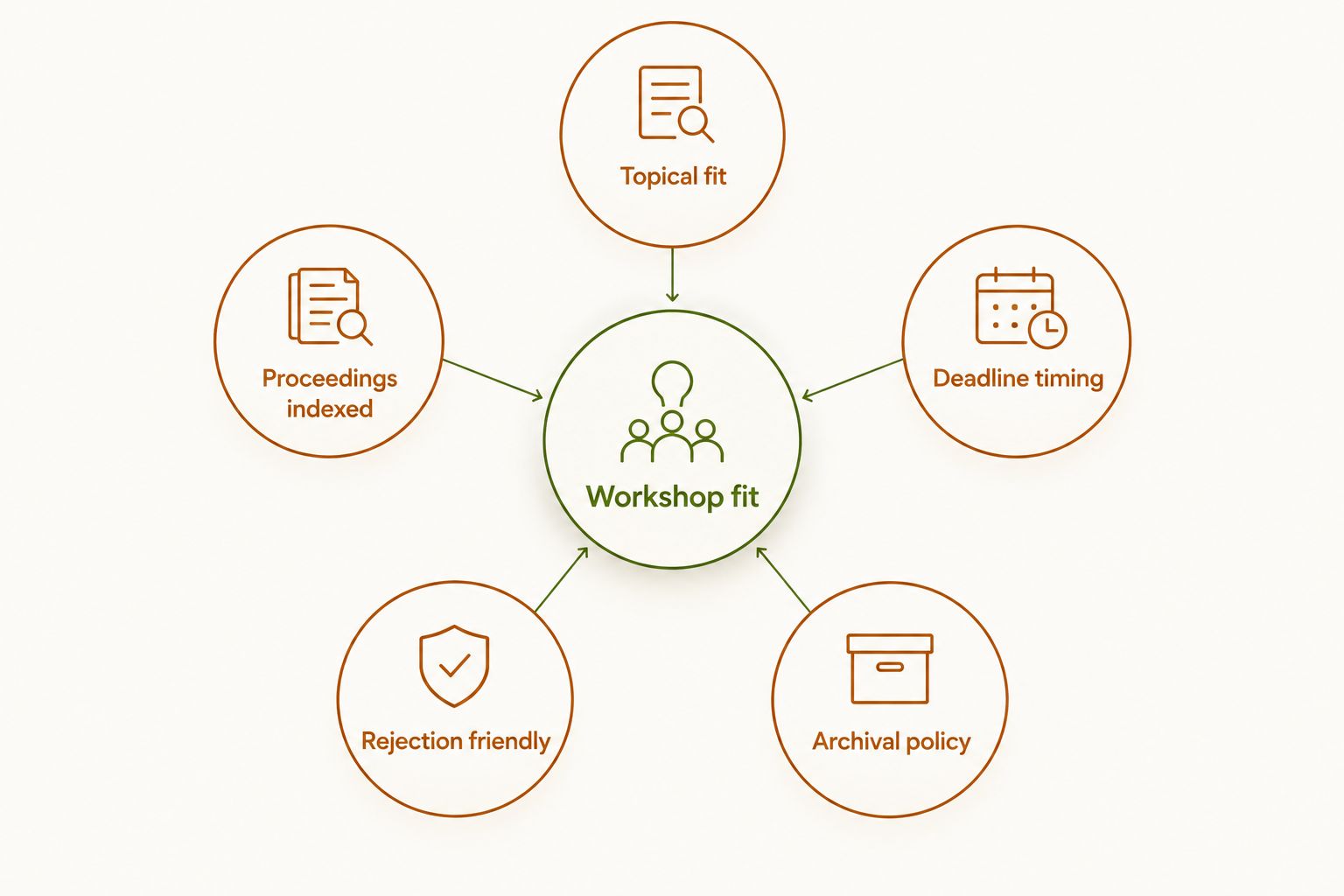
What makes the best ICML 2026 workshop match
- Topical fit between your paper's core contribution and the workshop's stated scope, not just shared keywords
- Deadline position relative to the ICML 2026 main-track decision date — workshops timed right after rejections give you a real shot at a fast resubmission
- Archival vs. non-archival policy — archival workshops publish proceedings that count as a prior publication; non-archival ones don't
- Explicit rejection-friendly language in the call for papers — some workshops openly solicit work already reviewed elsewhere, others don't
- Presentation format — in-person talk requirements exclude authors who can't travel; poster-only or remote options don't
- Proceedings indexing — whether the workshop's papers show up in a citable, searchable record later
ICML 2026 workshop categories at a glance
| Category | Best for | Standout feature | Key limitation |
|---|---|---|---|
| Foundation model / LLM workshops | Scaling and pretraining papers | Largest, most active reviewer pool | Highest submission volume, most competitive slots |
| Efficient ML and systems workshops | Compute-constrained contributions | Reviewers who value inference/training cost data | Narrower audience outside the systems subfield |
| Interpretability and safety workshops | Alignment and explainability work | Reviewers deep in mechanistic and behavioral analysis | Scope can be strict about what counts as "safety" |
| Multi-agent and RL workshops | Agentic systems and RL research | Consistent recurring track across ML conferences | Can split further into niche sub-tracks by method |
| ML for science / healthcare workshops | Domain-application papers | Reviewers who understand the applied domain, not just the ML | Domain reviewers may weight novelty differently than a main-track reviewer |
| Non-archival / work-in-progress workshops | Early-stage or preliminary results | Keeps your paper eligible for later archival submission | Lower prestige signal on a CV line |
1. Foundation model and LLM workshops: best for scaling and pretraining papers
These workshops cluster around pretraining, scaling laws, instruction tuning, and evaluation of large models. They've been a recurring, high-volume category across ICML and its sibling conferences for several years running, and 2026 is very unlikely to be an exception given how much of the submitted research pool sits in this space.
Foundation model workshop pros:
- Reviewers are typically deep specialists in the exact subfield
- High visibility if your paper stands out in a crowded room
- Frequent overlap with industry lab attendees looking for new ideas
Foundation model workshop cons:
- Submission volume is the highest of any category, which compresses acceptance odds
- Scope can be broad enough that reviewers vary widely in what they consider novel
Best for: papers on pretraining, scaling behavior, or instruction-tuned model evaluation. Verdict: Submit if your contribution is squarely about model scale or capability; Skip if your paper's core claim is a smaller architectural tweak that will get lost in volume.
2. Efficient ML and systems workshops: best for compute-constrained contributions
This category covers quantization, distillation, inference optimization, and training efficiency work. It's a smaller, more technical room than the foundation model track, and reviewers here tend to weigh actual measured cost numbers over qualitative claims.
Efficient ML workshop pros:
- Reviewers expect and reward hard efficiency numbers (latency, memory, FLOPs)
- Less submission volume than foundation-model-focused tracks
- Strong fit for papers that got told "not novel enough" at the main track for lacking scale
Efficient ML workshop cons:
- Audience is narrower — less useful if your paper needs broad exposure
- Weak fit if your paper doesn't report concrete efficiency metrics
Best for: papers with measured training or inference cost reductions. Verdict: Submit if you have real numbers to show; Wait and add benchmarks first if you don't.
3. Interpretability and safety workshops: best for alignment and explainability work
These workshops focus on mechanistic interpretability, behavioral evaluation, and alignment methods. They've grown steadily as a recurring category at major ML venues, and reviewers here read differently than a general main-track committee — they're looking for rigor in the analysis, not just a new benchmark score.
Interpretability workshop pros:
- Reviewers are specifically trained to evaluate explanatory or safety claims
- Strong home for papers that got dinged at the main track for "limited empirical scope"
- Growing community means growing citation exposure for good work
Interpretability workshop cons:
- Scope definitions of "safety" vary by workshop and can exclude adjacent work
- Smaller audience than foundation-model tracks
Best for: papers analyzing model internals, failure modes, or alignment techniques. Verdict: Submit if your paper's contribution is explanatory rather than purely performance-driven.
4. Multi-agent and RL workshops: best for agentic systems and RL research
Multi-agent coordination, reinforcement learning theory, and agentic system design have had a stable, recurring presence across ICML-adjacent workshops for years. This category tends to be more methodologically strict than the foundation model track.
Multi-agent/RL workshop pros:
- Reviewers with deep RL-specific background, not generalists
- Good fit for theory-heavy papers that don't need a huge empirical benchmark
- Consistent year-over-year presence, so scope is predictable
Multi-agent/RL workshop cons:
- Can fragment into sub-tracks (single-agent RL vs. multi-agent vs. game-theoretic) where your paper needs to pick the right one
- Less relevant if your work is purely supervised learning
Best for: RL theory, multi-agent coordination, or agentic system papers. Verdict: Submit if your paper is squarely RL or multi-agent; Skip the mismatch of forcing a supervised-learning paper into this room.
5. ML for science and healthcare workshops: best for domain-application papers
These workshops pair ML methods with a specific applied domain — biology, chemistry, medicine, climate. Reviewers usually include domain experts alongside ML researchers, which changes what counts as a strong contribution.
ML-for-science workshop pros:
- Domain reviewers value real-world applicability over pure novelty
- Good landing spot for papers rejected at the main track for "incremental methods, but strong application"
- Smaller, more targeted audience actually working in your domain
ML-for-science workshop cons:
- Domain reviewers may not weigh methodological novelty the way an ML-only committee does
- Cross-listing risk if your paper doesn't clearly serve the domain's actual problems
Best for: applied papers where the domain contribution matters as much as the ML method. Verdict: Submit if the application is central to your framing.
“A workshop rejection rarely means the research is weak. It usually means the paper picked the wrong workshop.”
6. Non-archival / work-in-progress workshops: best for early-stage or preliminary results
These workshops explicitly don't publish archival proceedings, which means the paper you submit stays eligible for a full archival venue later. They're the safest option when you're not sure your work is finished enough for a permanent publication record.
Non-archival workshop pros:
- Keeps the paper open for later submission to a full conference or journal
- Lower barrier for preliminary or in-progress results
- Good venue for getting early feedback without burning a publication slot
Non-archival workshop cons:
- Carries less weight on a CV than an archival publication
- Some committees still expect a reasonably complete result, not a rough draft
Best for: preliminary results, work you plan to expand into a full paper later. Verdict: Submit as a low-risk option whenever you're unsure a paper is main-track ready.
How we ranked these categories
The order above tracks the criteria listed earlier: topical breadth first, then rejection-friendliness, then how forgiving the deadline timing tends to be relative to ICML 2026's main-track decisions. Foundation model and LLM workshops rank first purely on submission volume and reviewer depth, not because they suit every paper — the category-by-category breakdown exists specifically so you don't default to the biggest room.
Check open ICML 2026 workshop calls
See current deadlines and extensions before you commit to a category.
Which ICML 2026 workshop should you submit to?
If your paper is squarely a foundation-model or LLM contribution, start with that category — the reviewer pool is the deepest even if the odds are tighter. If your paper got rejected from the main track and you're not sure it's a strong workshop fit anywhere, default to a non-archival workshop — it keeps your options open for a later archival submission and carries the lowest downside. Everyone else should match the table above to the actual claim in the paper, not the workshop with the most name recognition.
If you're also targeting other venues, the workshop landscape at the 15 best CVPR workshops to submit your paper to follows a similar logic — topical fit and archival policy matter more than the conference name attached to the workshop.
FAQ
What is the best ICML 2026 workshop to submit a paper to?
There's no single best ICML 2026 workshop — the right pick depends on whether your paper's core contribution is a foundation model result, an efficiency measurement, an interpretability analysis, or an applied-domain paper. Match the category to your paper's actual claim, not the workshop's popularity.
When do ICML 2026 workshop submission deadlines open?
Each ICML 2026 workshop sets its own deadline independently of the main conference, and these are typically announced by each organizing committee separately. Deadlines and extensions change during the call period, so check them close to submission rather than relying on an early announcement.
Can I submit a paper rejected from the ICML 2026 main conference to a workshop?
Yes, and many workshops explicitly welcome main-track rejections in their call for papers. Confirm the specific workshop's policy first, since not every workshop states this openly.
Are ICML workshop papers archival?
Some ICML workshops publish archival proceedings and some don't; this varies by individual workshop, not by the conference as a whole. Non-archival workshops let you resubmit the same work to a full venue later, which archival ones don't.
Is an ICML 2026 workshop harder to get into than the main conference?
It depends on the workshop's category and submission volume. Foundation model and LLM workshops tend to draw the deepest pool of submissions, while niche application or systems workshops usually see fewer competing papers.
Do ICML workshops require in-person attendance?
Some do and some offer poster-only or remote presentation options; this is set by each individual workshop's organizing committee, not by ICML as a whole. Check the specific workshop's call before assuming either way.
How many workshops does ICML host each year?
ICML has historically hosted a large number of affiliated workshops each year, though the exact 2026 lineup is finalized and published closer to the conference. The current accepted list is the reliable source once organizers confirm it.
Should I pick a workshop based on acceptance rate?
No — pick based on topical fit first. A workshop with a higher acceptance rate but the wrong scope wastes a submission slot just as badly as a rejection from a well-fitting one.
One last thing
Workshop deadlines get extended more often than main-track deadlines do — organizing committees are smaller and more flexible, and a 1-2 week extension after the original call is common across ML workshops generally. Don't treat the first posted date as final; check it again closer to submission before you assume you've missed the window for ICML 2026.