Picking the right NeurIPS 2026 workshop to submit to comes down to three things: topic fit, whether the call for papers is actually confirmed, and how the deadline lines up with your draft. This guide ranks the workshop categories that matter most and tells you where to verify current 2026 status before you write a single line of a submission.
- NeurIPS 2026 workshops open on a rolling schedule through 2026 — confirm each call before drafting.
- Match topic scope first, deadline timing second; a perfect-fit workshop with a tight deadline still beats a loose-fit one with room to spare.
- Recurring themes like ML for health and robot learning return most years, but 2026 approval isn't automatic.
- Non-archival workshops trade citation weight for faster feedback and lower submission friction.
- Extensions and cancellations happen every NeurIPS cycle — check status against the confirmed CFP, not last year's dates.
Why this matters
NeurIPS runs its main conference every December, and workshops are approved fresh each cycle by the program committee — a workshop that ran in 2025 is not guaranteed a slot in 2026. Submitting to a workshop whose call never got confirmed, or whose deadline already passed, wastes a paper cycle you don't get back.
AI Workshop Tracker lists open NeurIPS 2026 workshop calls as they get posted, alongside deadlines, extensions, and prior years' accepted-paper lists where available. Use that list to verify anything below before you commit a submission.
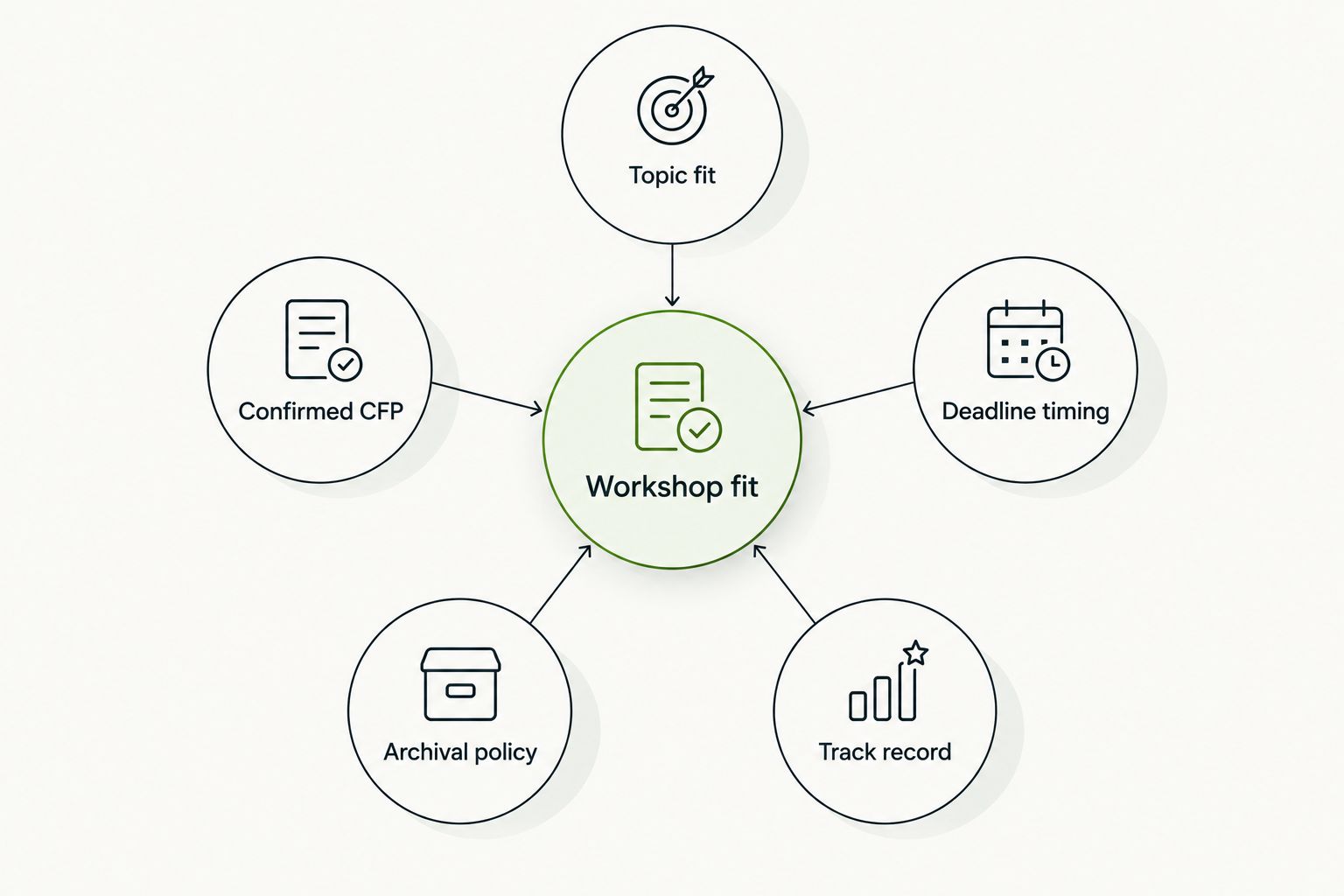
What makes the best NeurIPS 2026 workshop for your paper
- Topic fit — the workshop's stated scope actually matches your paper's contribution, not just its keywords
- Confirmed CFP — the call for papers has posted, with a real deadline, not a placeholder from a prior year
- Deadline timing — enough runway between now and the deadline to finish experiments and writing
- Archival policy — proceedings vs. non-archival matters if you plan to resubmit an extended version elsewhere
- Track record — the workshop has run in prior NeurIPS cycles, which signals organizer follow-through
- Review load — workshops attract more submissions when they're high-profile, which affects your odds
NeurIPS 2026 workshop categories at a glance
| Category | Best for | Standout feature | Key limitation |
|---|---|---|---|
| Flagship recurring themes (e.g. ML for health, robot learning) | High-profile visibility | Multi-year track record at NeurIPS | Higher submission volume, more competitive review |
| Niche technical tracks | Precise topic fit | Narrow scope filters out mismatched reviewers | Smaller audience, fewer citations |
| Non-archival workshops | Fast feedback, resubmission strategy | No archival conflict with a later journal or conference version | Doesn't count as a formal publication |
| Late-cycle / rolling-deadline workshops | Papers finished close to the main deadline | More runway before submission closes | Less lead time to iterate after reviews |
| New or first-year workshops | Emerging subfields without an established venue | Lower review volume in year one | No prior-year data to gauge acceptance patterns |
1. Flagship recurring themes: best NeurIPS 2026 workshop category for visibility
Themes like machine learning for health, robot learning, and efficient NLP have appeared at NeurIPS across multiple prior cycles. That history is a signal the organizing committee has a working track record, not a guarantee the exact workshop returns in 2026 under the same name.
Flagship theme pros:
- Established organizer teams with prior review experience
- Larger, more engaged audience at the workshop session itself
- Easier to find the prior year's accepted-paper list for calibration
Flagship theme cons:
- Higher submission counts mean more competitive review
- 2026 approval still requires a confirmed CFP — check before assuming continuity
Best for: researchers who want their workshop paper seen by the largest possible in-room audience. Verdict: Buy — but only once the 2026 call is confirmed on the tracker.
2. Niche technical tracks: best NeurIPS 2026 workshop category for precise topic fit
Smaller, tightly scoped workshops define their subject narrowly — a specific model class, a specific application domain, a specific failure mode. Narrow scope means reviewers are closer to your subfield.
Niche track pros:
- Reviewers understand the subfield's baselines without extra framing
- Less crowded submission pool than flagship themes
- Feedback tends to be more technically specific
Niche track cons:
- Smaller audience at the session and in citations afterward
- Some niche workshops don't return year over year
Best for: a paper whose contribution is too specific for a general track. Verdict: Buy if the scope statement in the CFP names your exact subproblem.
3. Non-archival workshops: best NeurIPS 2026 workshop category for resubmission strategy
Non-archival workshops publish extended abstracts or short papers without counting as a formal proceedings entry. That matters if you're planning to submit an extended version to a journal or a full conference later.
Non-archival pros:
- No archival conflict with a future submission of the full paper
- Faster turnaround from submission to feedback than most main-track reviews
- Lower bar to submit early-stage or in-progress work
Non-archival cons:
- Doesn't count as a citable publication on its own
- Some hiring and tenure committees don't weight non-archival venues the same as archival ones
Best for: work that's still moving toward a full paper and needs early feedback without burning the archival option. Verdict: Buy for in-progress research; Skip if you need a citable record now.
4. Late-cycle and rolling-deadline workshops: best NeurIPS 2026 workshop category for tight timelines
Not every workshop's deadline lands at the same point in the cycle. Some post calls later in 2026 and set deadlines closer to the main conference, which helps if your experiments are still running.
Late-cycle pros:
- More runway to finish results before the deadline
- Often less crowded than workshops with deadlines that align with paper-writing season
Late-cycle cons:
- Compressed time between acceptance and camera-ready
- Less lead time to act on reviewer feedback before the session
Best for: a paper that's close but not finished when flagship-theme deadlines pass. Verdict: Hold — track the CFP and confirm the deadline before assuming it fits your timeline.
5. New or first-year workshops: best NeurIPS 2026 workshop category for emerging subfields
Subfields that didn't have a dedicated venue in prior NeurIPS cycles sometimes get a first-year workshop in 2026. There's no prior accepted-paper list to check, which cuts both ways.
New workshop pros:
- Lower submission volume in a workshop's first year
- A natural fit for work in a subfield without an established home venue
New workshop cons:
- No track record to gauge review rigor or acceptance patterns
- Higher risk the workshop doesn't return in future cycles
Best for: work in a genuinely new subfield with no better-fitting established track. Verdict: Hold — confirm the CFP is live and the organizing team is named before submitting.
How this ranking was built
Each category above is scored against the six criteria listed earlier: topic fit, confirmed CFP status, deadline timing, archival policy, track record, and expected review load. Flagship themes rank first on visibility and track record; niche tracks rank first on topic-match precision; non-archival and late-cycle categories solve for timing constraints rather than prestige.
Which NeurIPS 2026 workshop should you submit to?
If your paper fits a flagship recurring theme and the CFP is confirmed, submit there first — the audience size and track record outweigh the higher review bar. If your contribution is narrow and technical, a niche track gets you sharper reviewer feedback. If you're not sure your results will be finished in time, a late-cycle or non-archival workshop keeps your options open without forcing a rushed submission.
Whatever category fits, confirm the 2026 CFP is live before you write toward it — a workshop that ran in a prior year is not a promise it runs again.
Check open NeurIPS 2026 calls
Live deadlines, extensions, and prior accepted-paper lists in one place.
FAQ
When do NeurIPS 2026 workshop calls for papers open?
Calls open on a rolling basis through 2026 as each workshop's organizing committee gets approved and posts its own timeline. There's no single fixed date across all workshops — check each workshop's individual CFP for its posted deadline.
How many workshops does NeurIPS accept each year?
The number varies by cycle and is set by the program committee's approval process each year. Confirmed 2026 workshop listings are tracked as they post rather than fixed in advance.
Are NeurIPS workshop papers archival?
It depends on the individual workshop. Some publish archival proceedings, others publish non-archival extended abstracts — check each workshop's policy before deciding whether to submit an extended version elsewhere later.
Is a NeurIPS workshop paper less valuable than a main-track paper?
Workshop papers generally carry less weight than main-track accepted papers because review is typically lighter and the venue is smaller. They're still useful for early feedback, visibility in a subfield, and building toward a full submission.
Can I submit the same paper to multiple NeurIPS 2026 workshops?
Most workshops prohibit submitting the same paper to multiple workshops in the same cycle, and some require it not be under review elsewhere. Read each workshop's submission policy directly since terms vary.
Do NeurIPS workshops extend their deadlines?
Extensions happen most cycles for at least some workshops, but they're not guaranteed and vary workshop to workshop. Treat the posted deadline as final unless an extension is explicitly confirmed.
How do I find which NeurIPS 2026 workshop fits my paper?
Match your paper's contribution against each workshop's stated scope in its CFP, not just its title or acronym. Narrow, precisely worded scopes usually indicate a workshop reviewing for that exact subproblem.
What's the difference between a NeurIPS workshop and the main conference track?
The main track is NeurIPS's primary peer-reviewed venue with the highest bar and largest audience; workshops are smaller, topic-specific sessions approved separately each year, often with lighter review and faster turnaround.
One last thing
The biggest mistake researchers make isn't picking the wrong workshop category — it's submitting toward a deadline that was never actually confirmed for 2026. Verify the CFP is live before you plan a submission timeline around it, especially for workshops that changed names or scope between cycles.